Tientietnikov’s lethargy and withdrawal
Dead SoulsTientietnikov’s lethargy and withdrawal turn an apparently gifted man’s promise into an existence of suspended intentions: he imagines a work that will explain Russia, yet spends his days indoors, lets his responsibilities decay, and cannot translate private regret into action. The state is at once comic in its particulars and painful in its implications, because the idleness conceals not an absence of ambition but the frustrated knowledge that he has failed to fulfill it.
The Shape of an Inactive Day
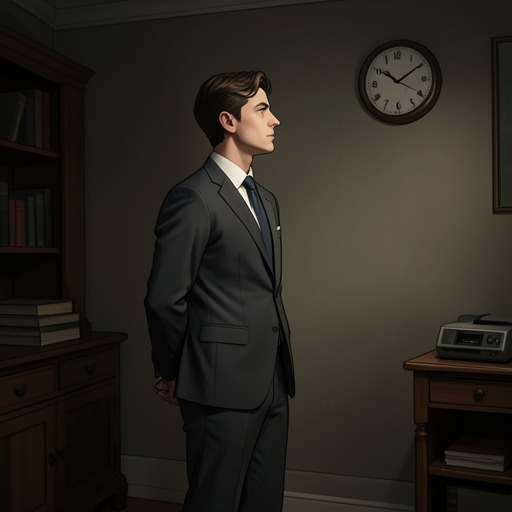
The narrator first calls Tientietnikov a star-gazer, then offers a specimen day as a measure of the habit. The day begins late: he sits on his bed rubbing his small eyes so long that his valet, Mikhailo, waits by the door with a towel and basin for an hour, leaves for the kitchen, and returns to find his master still there. When Tientietnikov at last rises, he moves through washing and dressing into a prolonged breakfast of tea, coffee, cocoa, warm milk, bread, and tobacco ash. He spends two hours over the meal, pours himself another cup of cooling tea, and goes to the window.
The window does not open onto the countryside’s celebrated beauty so much as the household’s daily tumult. Watching and listening to the quarrel between the serf Grigory, who acts as butler, and the housekeeper Perfilievna, Tientietnikov finds the surrounding noise too distracting to concentrate on anything. The episode fixes a pattern: he is present at the estate but does not direct its life, and even the effort to attend to a task is defeated by the commotion around him.
A couple of hours before luncheon, he withdraws to his study with the prospect of an immense undertaking. He means to consider Russia politically, philosophically, and religiously, address problems facing the Empire, and define the country’s great future. The scale of the intended work makes its failure all the more conspicuous. After gnawing a pen and putting a few strokes on paper, he lays it aside for a book; he reads through luncheon, lights a pipe, plays chess alone, and does more or less nothing for the rest of the day.
The routine is sustained rather than occasional. At thirty-three, Tientietnikov remains in slippers and a dressing-gown, does not go out or seek dissipation, cares nothing for fresh air, and scarcely notices the landscape that visitors admire. He does not even walk upstairs. The narrator places him among familiar figures of habitual sloth, but leaves open whether such a character is innate or produced by later misfortune. That uncertainty matters: the portrait records a settled condition while preparing to trace its formation.
Ambition Without Completion
The projected work on Russia gives Tientietnikov’s inactivity its particular shape. He is not shown without ideas; he is occupied by an idea so comprehensive that its intended reach—from the state’s problems to its future—far exceeds what he can bring to the page. Projection becomes a substitute for completion. A few marks of the pen are followed by reading, and the day that was meant to serve a national undertaking dissolves into private routine.
The contrast between the work’s public scale and the isolation of its author is sharp. Tientietnikov imagines defining Russia’s future, yet does not leave his rooms or attend to the daily obligations of his estate. His grand design does not organize his life; instead, the distance between imagined achievement and present conduct enlarges the sense of wasted capacity. The narrative makes the unfinished project more than a failed piece of writing: it is the clearest expression of a will that can conceive an aim but cannot sustain the labor required to reach it.
Withdrawal and Neglect
As the pattern hardens, withdrawal extends beyond the study. Tientietnikov’s residence becomes a place of dirt and neglect. A broom and a heap of dust can remain in the middle of a room for days; trousers are left tossed about the salon, and worn-out braces adorn the what-not near the sofa. The accumulation makes the inner condition visible in the rooms he inhabits. In the narrator’s account, the disorder becomes so mean and habitual that even the servants and the poultry cease to treat their master with respect.
The neglect also reaches his dealings with the estate. He stops visiting the fields and shuts himself in his rooms, refusing even to receive the bailiff when that official arrives with reports. This is not merely a preference for solitude: it cuts off the practical contact through which the estate might be managed. The reader sees an outward consequence of his inaction in the abandoned duties and the neglected household, while the estate’s ordinary business continues to arrive at his door unanswered.
His retreat is selective in its objects but not productive in its results. At times he sits with a pen, sketching houses, huts, wagons, troikas, and flourishes on paper. Such drawing does not become the great work he projected, nor does it restore order to his affairs. It is another form of occupation that leaves the larger responsibilities untouched: the hand moves, but the work that might give direction to his life remains undone.
Regret, Memory, and the Lost Call to Action
For all the apparent sameness of his days, the narrator insists that Tientietnikov does not remain wholly insensible. When newspapers and reviews arrive, a report of a former comrade’s success in public service, science, or other work can provoke a secret grief. He feels an aching regret that he himself has done so little; at such moments his existence seems odious and repellent. The printed pages bring achievement within view and make his own inaction harder to evade.
That regret returns him to the memory of Alexander Petrovitch, his exceptional teacher. The figure appears to him as vividly as in life, and tears slowly run down his cheeks. The remembered teacher stands for a kind of moral encouragement that Tientietnikov no longer possesses. The narration interprets his pain as evidence that he has failed to order his life aright and to hold fast to the lofty aims with which he began. He was poorly equipped by experience to reach and strengthen himself in a better state, and his superior instincts, like overheated metal, never received their final tempering.
The loss of Alexander Petrovitch deepens the failure. Tientietnikov has no one left who can restore the moral strength weakened by vacillation or the will power eroded by lack of resolve. What he needs, the narrator argues, is a voice able to cry to his soul, “Forward!” The appeal expands beyond one man: the narrator describes Russians of every class, occupation, and school of thought as hungry for such a command, while youth remains caught in sloth or struggles without purpose. Tientietnikov’s private stagnation therefore becomes an instance of a broader national longing for direction, framed not as proof that he lacks aspiration but as grief over aspirations that have found no effective guide.
Significance of the State
The force of the portrait comes from the distance between intention and consequence. A man who proposes to think through Russia’s political, philosophical, and religious condition cannot manage to complete a few lines; one who remembers lofty aims does not visit his fields or receive the bailiff. Each scale of failure reflects the other. The uncompleted manuscript, abandoned household work, and refusal of estate reports show how a great project and small duties alike remain suspended.
Yet the tears prevent the portrait from settling into a simple caricature of laziness. Tientietnikov recognizes what has gone wrong, remembers the teacher who once offered moral force, and suffers when evidence of other people’s achievements reaches him. Regret does not, in these episodes, become reform: it returns him to sorrow and inactivity. The state is thus marked by the painful coexistence of conscience and incapacity, with awareness registering the loss but not overcoming it.
In narrating the routine at length, the book makes inactivity perceptible through its accumulating particulars: the waiting valet, the cooling tea, the scattered tobacco ash, the half-written pages, and the dust left in the middle of a room. The delay itself becomes part of the subject. Instead of treating idleness as an abstract defect, the portrait shows time repeatedly passing through small actions and abandoned tasks, until withdrawal has become both a daily schedule and a damaged relation to work, land, and the future.